Staying Planted: Why Patience Beats Prediction


CRAIG LOKEN, ASSOCIATE PORTFOLIO MANAGER
Across the Midwest, nobody needs to explain patience to a farmer. A hailstorm in June is painful to watch, but no one responds by plowing the field. The crop remains planted because it is not time to harvest until October.
Markets often reward the same patience. When volatility picks up, the temptation is to make changes until things “settle down,” and get back into the market when the coast feels clear. The problem is that markets rarely send an all-clear signal. As with the crop, the market has good days and bad days. The field stays in place to facilitate the long-term goal, the harvest.
The Cost of Leaving the Field
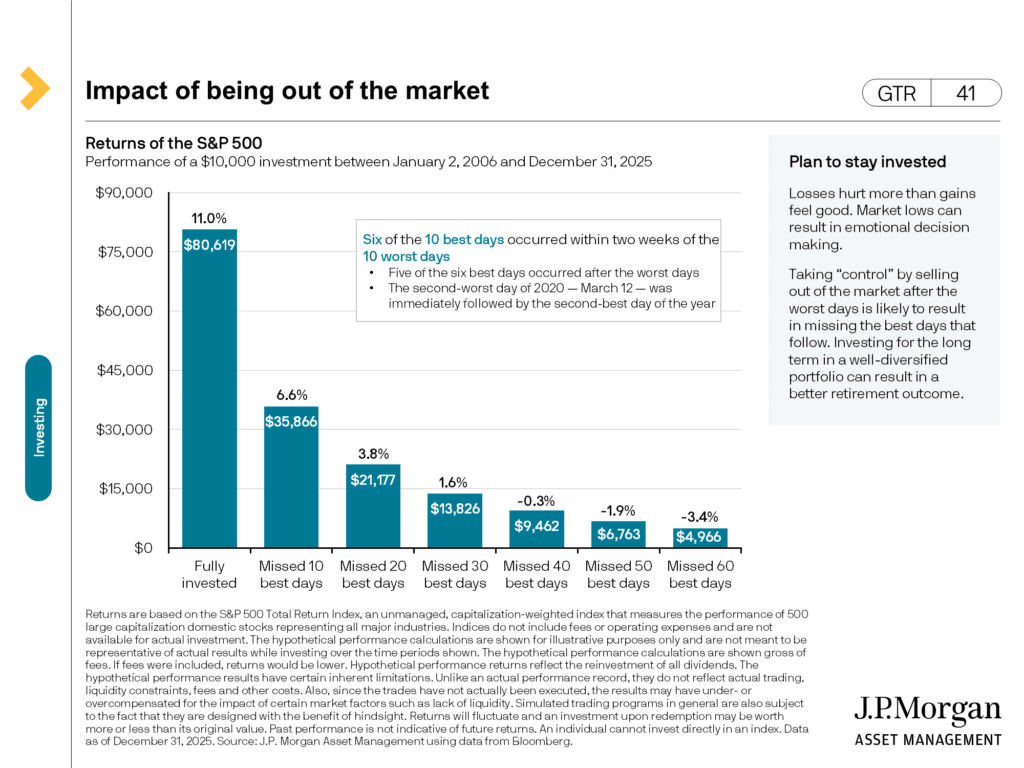
J.P. Morgan Asset Management recently looked at a hypothetical $10,000 investment in the S&P 500 Total Return Index over the 20 years ending December 31, 2025. If that investment had remained fully invested, it would have grown to $80,619, an 11.0% annual return.
But missing the ten best market days reduced the ending value to $35,866. Missing the twenty best days brought it down to $21,177. Missing forty of the best days over that 20-year period resulted in a loss on the initial $10,000 investment.
That is the difficult part about trying to time the market in that it does not require being wrong for extended periods for gains or losses to magnified.
The Catch: The Best Days Often Arrive Near the Worst Ones
The market’s best days do not always show up when things feel calm. According to J.P. Morgan, six of the ten best days during that 20-year period occurred within two weeks of the ten worst days. In 2020, the second-worst day of the year was immediately followed by the second-best day of the year.
That is what makes selling during a rough stretch so difficult. It requires two good decisions: when to get out and when to get back in. The second decision can be much more difficult because the strongest rebounds can happen while the headlines still feel uncomfortable.
Selling can make you feel like being in control but when these moves are based on emotion, it can turn temporary declines into permanent setbacks.
What Patient Investors Do Instead
Staying invested does not mean ignoring risk or refusing to make changes. It means making changes for the right reasons.
Patient investors stay focused on their overall plan and rebalance on a well thought out schedule. The patient investor often trims what has done well and adds to what has lagged. They adjust portfolios for things like retirement, income needs, taxes, estate planning, or family circumstances, rather than reacting to the market’s mood.
That distinction matters. Discipline is not simply sitting idle; it is making decisions on your timeline instead of the market’s.
The Bottom Line
Volatility is the weather. Your plan is the field.
Storms are uncomfortable and can often make you want to run for cover, but that strategy can often lead to missing the beautiful rainbow. History has consistently shown that long-term success is based less on prediction and more on participation.
If recent market noise has you wondering whether your portfolio has the right ingredients and should stay planted, that is a conversation worth having with your financial advisor.